
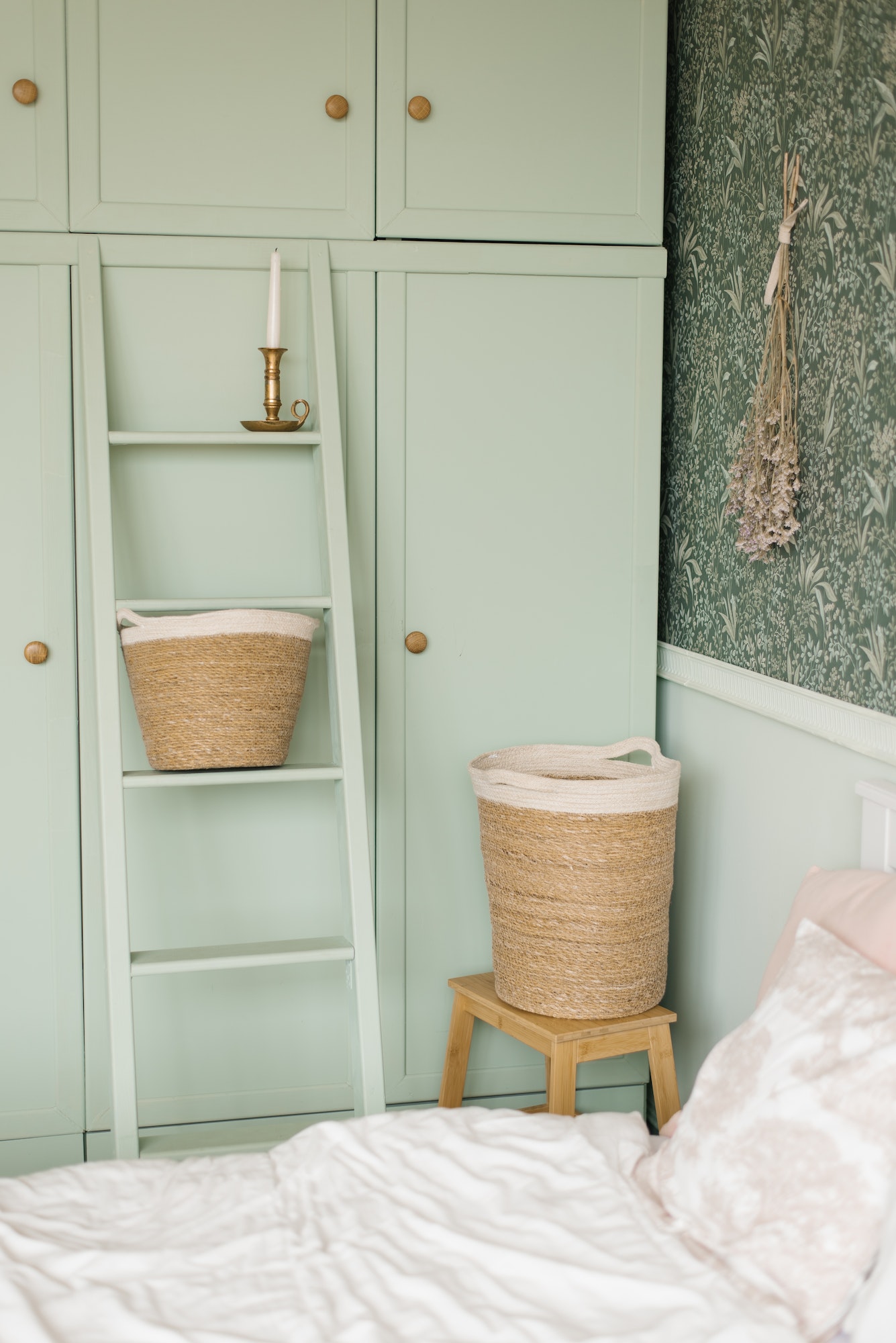
Almost every guide to refurbishing wardrobe doors opens the same way: sand them down. That instruction is fine on a solid wood door and quietly disastrous on the melamine faced ones fitted in most bedrooms since the 1980s.
In brief
- Test the substrate first: a hidden edge tells you everything.
- Melamine needs an adhesion primer, not aggressive sanding.
- Never dry sand old paint in a home built before 1949.
- A 30 cm moulding frame centres neatly on a 50 cm door.
Step zero: identify the door
Take one door off and look at a hidden edge, ideally where a hinge sits or along the bottom. What you find there decides the entire preparation route.
Solid wood or wood veneer
You will see grain running through the edge, or a thin ribbon of real timber wrapped over a core. Both sand happily. Work through the grits, keep the sander moving, and on veneer go gently: it can be well under a millimetre thick and once you sand through it there is no going back.
Melamine or laminate faced board
The edge shows a chipboard or MDF core with a plastic film or a printed paper skin over it. This surface is designed not to accept anything. Sanding it hard just breaks through into the core. The route here is: degrease thoroughly with a household cleaner, key the surface with a fine abrasive so it loses its sheen without being scratched, dust off completely, then apply an adhesion primer made for laminate. Two thin coats beat one thick one every time, and a light de-nibbing at 240 grit once the primer is dry gives the topcoat something to hold onto.
Old painted doors, whatever is underneath
If the paint is original and the building is old, stop before reaching for the sander. Lead based paint was used domestically for decades, and dry sanding turns it into invisible dust. The regulatory thresholds make a useful rule of thumb: France requires the lead risk assessment known as the CREP for housing built before 1949, and United States federal rules treat homes built before 1978 as presumed to contain lead paint. Older than that and unidentified? Have it assessed, or paint over it after a gentle wet clean rather than sanding.
What you need on the table
- Hardwood half round moulding, meranti or similar
- Mitre box and a fine saw
- Sander, plus abrasive papers in two or three grits
- Hammer and panel pins
- Screwdrivers, pencil, tape measure
- Wood filler
- No nails adhesive, such as Pro Nails glue
- Adhesion primer if the doors are melamine
- Enamel paint, roller and tray
- Masking tape and a dust mask
Adding the moulding, with the arithmetic done for you
A raised frame is what turns a flat slab into something that looks deliberate, and the geometry only needs doing once. On a standard 50 by 50 cm door, cut your half round into 30 cm lengths: that leaves a clean 10 cm margin on either side, which reads as generous rather than mean.
- Mark the centre lines in pencil on each door, and dry lay the four pieces before cutting anything permanently.
- Cut the mitres at 45° in the mitre box, four pieces per door, checking that opposite lengths match exactly rather than approximately.
- Run a few blobs of adhesive along the back of each piece, spaced evenly rather than in one continuous bead, and press into place on the pencil marks.
- Pin each length while the glue grabs. Wipe any squeeze out immediately with a damp cloth, because dried adhesive shows through paint like a scar.
- Fill the mitre joints with wood filler, let it cure and sand flush. This is the difference between homemade and made at home.
Painting: fewer coats than you think, thinner than you want
Enamel earns its place on cupboard doors because it cures to a hard, wipeable film that copes with fingers and hangers. It also punishes impatience: a thick coat sags and stays soft for days.
Mask the mouldings if you want the two tone effect, doors in colour against white beading, and press the tape edge down firmly with a fingernail before the first coat. Then work thin, let each coat dry fully rather than to the touch, and lift the tape while the final coat is dry but still fresh rather than days later.
One label worth reading while you choose. Since 1 September 2013, paints and varnishes sold in France must carry an indoor emissions rating from A+ for very low emissions down to C, under the decree of 23 March 2011. In a bedroom, where the door will be off gassing a metre from a pillow, that letter is worth more than the shade name on the front of the tin.
Refitting, and the bit everyone rushes
Let the doors cure properly before they go back, longer than the tin’s recoat time suggests, especially in humid coastal air. Then rehang from the top hinge down, and adjust before you decide the job went wrong: most modern hinges have two or three adjustment screws that move the door sideways, in and out, and up and down. A door that looks crooked is usually a door that has not been adjusted.
Can I just paint over the existing colour? On sound, well keyed paint, yes. On anything glossy, degrease and key it first or the new coat will peel off in sheets at the first knock.
What about the handles? New handles on refurbished doors change the whole cupboard for very little money, but check the hole centres before ordering. Filling and redrilling a painted door is a job nobody enjoys twice.
The same patience with preparation applies whether you are doing doors or whole walls, and the trade offs are much the same: I set them out in my notes on painting your own walls rather than calling someone.
Finishing the bedroom while you are at it
New cupboard doors deserve better than the headboard you have been meaning to replace.
Updated 17 August 2026. Sources consulted: trade guidance on painting melamine and laminate surfaces, including degreasing, keying and adhesion primers; French rules on the constat de risque d’exposition au plomb for housing built before 1949 and United States Environmental Protection Agency guidance for homes built before 1978; décret n° 2011-321 of 23 March 2011 and the order of 19 April 2011 on the labelling of volatile pollutant emissions from paints and varnishes, applicable since 1 September 2013. If you suspect lead paint, have it assessed rather than sanded.