The first cushion covers I ever made were technically perfect and looked awful. Straight seams, neat corners, and a sad flat pillow inside, like a shirt one size too big. Nobody had told me the one number that changes everything, and it is not a sewing number at all.
In brief
- Undersize the cover by 2 to 3 cm, never match the pad exactly.
- Add 1.5 cm seam allowance on every edge, after undersizing.
- Wash the fabric before cutting if the cover will ever be washed.
- An envelope back takes twenty minutes and needs no zip at all.
- 1 Why the cover has to be smaller than the pad
- 2 Picking a fabric that survives a Mediterranean summer
- 3 The cutting, in four numbers
- 4 Envelope back or zip: pick before you cut, not after
- 5 Sewing it without the corners betraying you
- 6 The mistakes I still see most often
- 7 Questions readers send me
Why the cover has to be smaller than the pad
Because a cushion pad is soft and a seam is not. Sewing rooms and cushion suppliers work to the same rule of thumb: a finished cover roughly one to two inches smaller than the insert, which is 2.5 to 5 cm in the units the rest of us use. The feather or fibre filling then pushes outward against the fabric and holds the shape. Match the pad exactly and the filling has room to settle into the centre, which is exactly the deflated look I spent a whole winter producing.
I stay at the low end, around 2 to 3 cm, for a fibre pad, and closer to 4 cm for a feather one, because feathers compress far more willingly. If you only ever remember one line from this article, make it that one.
Picking a fabric that survives a Mediterranean summer
The two things that destroy cushion fabric here are abrasion and light, in that order. Abrasion is measured by the Martindale test, set out in BS EN ISO 12947, which rubs a sample against an abrasive surface and counts the cycles until it breaks down. Suppliers publish that figure, and the bands they use look roughly like this.
| Martindale cycles | What it is sold for | Sensible use for a cushion |
|---|---|---|
| Under 10,000 | Decorative fabric | Bedroom or display cushion, nobody sits on it |
| 10,000 to 15,000 | Light domestic | Occasional chair, guest room |
| 15,000 to 25,000 | General domestic | The sofa everyone actually uses |
| 25,000 and above | Heavy duty | Family sofa, pets, holiday let |
Bands vary slightly from one supplier to the next, so read the figure rather than the adjective. Light is the second enemy and no rub count protects you from it: a cushion parked in front of a south-facing window will fade on one side and stay bright on the other. I rotate mine when I change the covers, which is the least glamorous decorating habit I have.
Whatever you buy, wash it before you cut it if the finished cover will ever go in the machine. Cotton and linen shrink on their first wash, and they shrink after you have sewn them just as happily as before.
The cutting, in four numbers
- Measure the pad itself, not the old cover, across the middle and from seam to seam. A 45 cm pad is often not quite 45 cm.
- Subtract 2 to 3 cm from the width and from the height. That result is your finished cover size.
- Add 1.5 cm of seam allowance to all four edges of that finished size. For a 45 cm pad you end up cutting pieces of about 45 cm square, which feels like a coincidence and is simply the two corrections cancelling out.
- Cut on the straight grain, following the weave rather than the printed pattern. A cover cut slightly off grain will twist on the pad and never sit square, however carefully you sew it.
Envelope back or zip: pick before you cut, not after
The closure decides how you cut the back panel, so choose now. An envelope back means two overlapping back pieces instead of one, each roughly two thirds of the cover height, with a hemmed edge where they cross. No hardware, no zip foot, and it is genuinely the version I recommend to anyone sewing their first cover.
A zip looks tidier and holds a firm pad better. Put it in the bottom seam rather than the back panel, choose a zip a few centimetres shorter than that seam, and be honest about the trade-off: too short and you will fight to get the pad in every single time you wash the cover. Match the thread to the fabric, not to the zip tape.
Sewing it without the corners betraying you
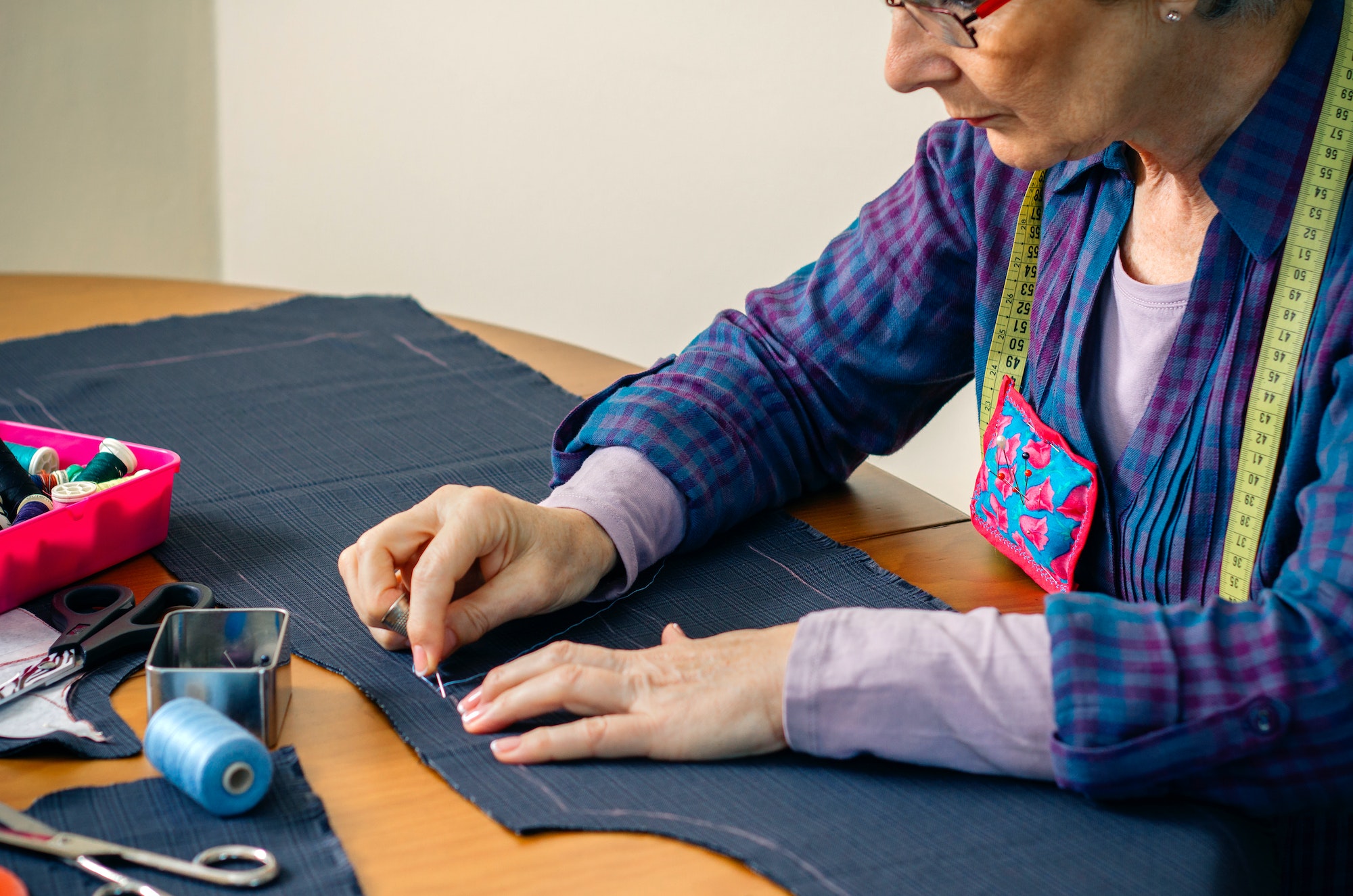
Pin the pieces right sides together, edges aligned, and sew all the way round at your 1.5 cm allowance, leaving the closure open. So far, so ordinary. The step people skip is the corners.
Trim each corner diagonally before turning, cutting close to the stitching without touching it. That removes the bulk of fabric that otherwise bunches inside the corner and makes it round. Turn the cover through, push the points out with something blunt like a chopstick rather than scissors, and press the seams flat. Then insert the pad, corner to corner first, middle last.
The mistakes I still see most often
- Measuring the old cover. It has already stretched. Measure the pad.
- Buying a pad to fit the cover. Do it the other way round, the pad is the fixed object.
- Skipping the pre-wash on linen, then wondering why the cover no longer fits after August.
- Using a decorative fabric on a sofa cushion because the pattern was irresistible. It will pill within a season.
Questions readers send me
Can I sew a cushion cover without a machine? Yes, with a backstitch by hand, and it will hold. It takes a long evening rather than half an hour, and I would only do it for a small decorative cushion.
What if my pad is a box cushion with a depth? Same logic, plus a side band cut to the depth of the pad with seam allowance added, and the same 2 to 3 cm undersizing applied to the top and bottom panels.
Do I need to finish the raw edges? On a cover you plan to wash, yes. A zigzag or an overlocked edge stops the seam allowance fraying into confetti in the drum.
Is outdoor fabric worth it for a terrace cushion? Here, yes. Solution-dyed acrylics hold their colour in strong sun far better than a printed cotton, and that is precisely the situation a terrace cushion lives in.
If you have fallen for the fabric but not the colour, dyeing the plain version is often cheaper than hunting for the exact shade: my notes on customising home textiles with fabric dye cover which fibres actually take the colour.
Enjoying the fabric side of decorating?
The same skills scale up to a much bigger surface, for a very small budget.
Updated 15 August 2026. Sources consulted: BS EN ISO 12947 for the Martindale abrasion method and the durability bands published by upholstery fabric suppliers; standard cushion sizing guidance from cover and insert manufacturers. Measurements and habits described in the first person are my own workshop practice, not a manufacturer instruction.