
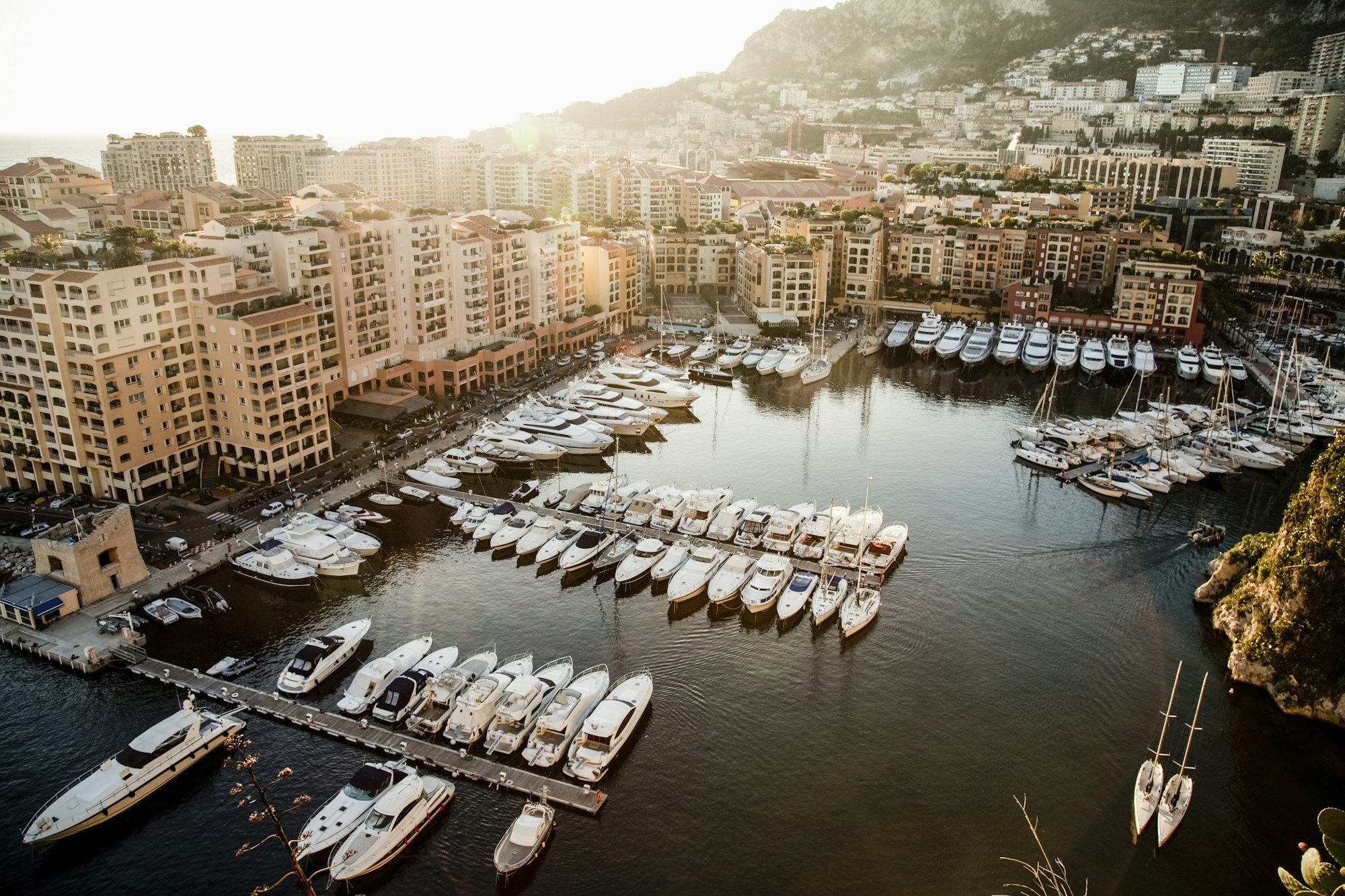
Monaco is twenty minutes from my kitchen and legally somewhere else entirely. People who have already bought and sold in France assume the process transfers across the border. It does not, and the gap starts with who is allowed to handle the file.
In brief
- Three notarial offices in Monaco: Rey, Aureglia-Caruso and Crovetto-Aquilina.
- Roughly 6.25% in duty and fees for a private buyer on a resale.
- The 10% deposit sits with the notary, not with the agent or the seller.
- Owning through a company changes the tax treatment substantially.
- 1 Why the French playbook does not apply here
- 2 The notary is not an administrative formality
- 3 The sequence, from first viewing to keys
- 4 What lands on top of the price
- 5 Holding property through a company: read this part twice
- 6 Buying does not make you a resident
- 7 Choosing the agency you will actually be stuck with
Why the French playbook does not apply here
Monaco is a sovereign state with its own civil code, its own registration duties and its own property tax logic, and none of it mirrors the department next door.
Three features shape everything else. There is no property tax and no capital gains tax on the disposal of a Monegasque property. Supply is physically capped, since the Principality covers barely two square kilometres and gains new ground only by building upwards or reclaiming from the sea. And the buyer pool is international, which means the market prices in what a flat represents as much as what it contains: the view, the floor level, the building’s concierge service and its address.
For a seller, that last point is the one to internalise. The person viewing your flat is comparing it against a lifestyle, not against a price per square metre spreadsheet. Presentation is not decoration here, it is part of the valuation.
The notary is not an administrative formality
In Monaco the notary is a public officer with a monopoly on real property transfers, and the file physically cannot close without one.
The notary verifies ownership, checks that the property is free of charges, mortgages or pre-emption issues, holds the deposit in escrow, drafts the deed of sale (acte de vente), collects the registration duty on behalf of the state and registers the transfer. Only three offices practise in the Principality, and their scale of fees is fixed rather than negotiated. Buyers coming from common law systems sometimes look for a solicitor to sit alongside; you can absolutely take separate legal advice, but it does not replace the notarial step.
The sequence, from first viewing to keys
A standard resale follows the same five stages, and the order rarely varies.
- Define the brief and the budget honestly, including acquisition costs, since they are paid in cash and not financed.
- Appoint an agency that actually works the buildings you are targeting. Monaco’s stock is small enough that agencies know individual apartments by name.
- Agree terms and sign the preliminary contract, the compromis de vente, which fixes the price, the conditions and the deadline. The buyer pays a deposit of 10% of the price, held in escrow by the notary.
- Let the notary run the verifications. This is the two months. Title, charges, the seller’s capacity to sell, and for a company-held property the identity of the beneficial owners.
- Sign the deed of sale, pay the balance and the duties, and take possession.
Selling reverses the same machine. Get a realistic appraisal, agree the marketing approach, review offers, then hand the accepted offer to the notary. The one thing worth insisting on as a seller is the buyer’s proof of funds before the compromis, because a broken chain here costs months in a market where the buying season is short.
What lands on top of the price
Acquisition costs in Monaco depend far more on how you own the property than on what you paid for it.
| Situation | Registration duty | Notarial fees |
|---|---|---|
| Resale, private name or transparent Monaco civil company | 4.75% | about 1.5% |
| New build or off-plan (VEFA), price includes VAT | 1% | about 1.5% |
| Purchase through a foreign or non-transparent company | 10% | about 1.5% |
Add the agency commission on top: 3% from the buyer, 5% from the seller, both subject to VAT at the rate in force. Ask your notary to confirm the applicable figures for your exact situation before you commit, because the ownership structure, not the postcode, is what moves them.
Holding property through a company: read this part twice
Company ownership is common in Monaco and it carries an ongoing obligation, not just a higher entry cost.
Under Law no. 1.381 of 29 June 2011, legal entities holding real property rights in the Principality must appoint an approved representative and file an annual declaration to the tax authorities stating whether the beneficial owners have changed. A change of beneficial owner is itself taxed, at a proportional rate of 4.75% on the market value of the property, on the logic that selling the company is economically the same as selling the flat. Monaco civil companies whose partners are exclusively individuals sit outside the annual declaration requirement.
None of this makes company ownership a bad idea. It makes it a decision to take with a tax adviser before signing anything, rather than a structure to unwind afterwards.
Buying does not make you a resident
The purchase and the residence permit are two separate files, and confusing them is the most common misconception I hear.
Anyone may buy in Monaco, including non-residents, with no nationality restriction on the acquisition itself. The carte de séjour is applied for separately and requires accommodation in the Principality (owning or renting satisfies that condition), proof of sufficient means, health cover, a clean criminal record, and for non-EU nationals a French long-stay visa obtained first, since Monaco sits inside the French border control area. There is no residence-by-investment scheme: the Principality asks you to show you can support yourself, not that you have spent a given sum.
Choosing the agency you will actually be stuck with
Reputation in a market this small is verifiable, so verify it.
Ask how many transactions the agency has closed in the specific building or district you are targeting, not across the Principality: a firm that sells constantly in Monte-Carlo may barely know Fontvieille. Ask who will physically attend the notary appointment with you. Ask, if you are selling, how they intend to reach international buyers rather than simply listing to the same local pool. And expect transparent communication about the fee scale, which is set rather than invented: an agent who is vague about their own commission will be vague about other things too. If negotiation is the part you dread, the general principles I set out on how to negotiate the price of a property down still hold, though the room for manoeuvre here is narrower than almost anywhere else on the coast.
This article is general information on how the process works, not legal, tax or financial advice. Every Monaco transaction turns on individual circumstances: take advice from a notary and a qualified tax adviser before committing.
Curious what you are actually buying into?
The Principality’s buildings tell you more about its market than any brochure.