
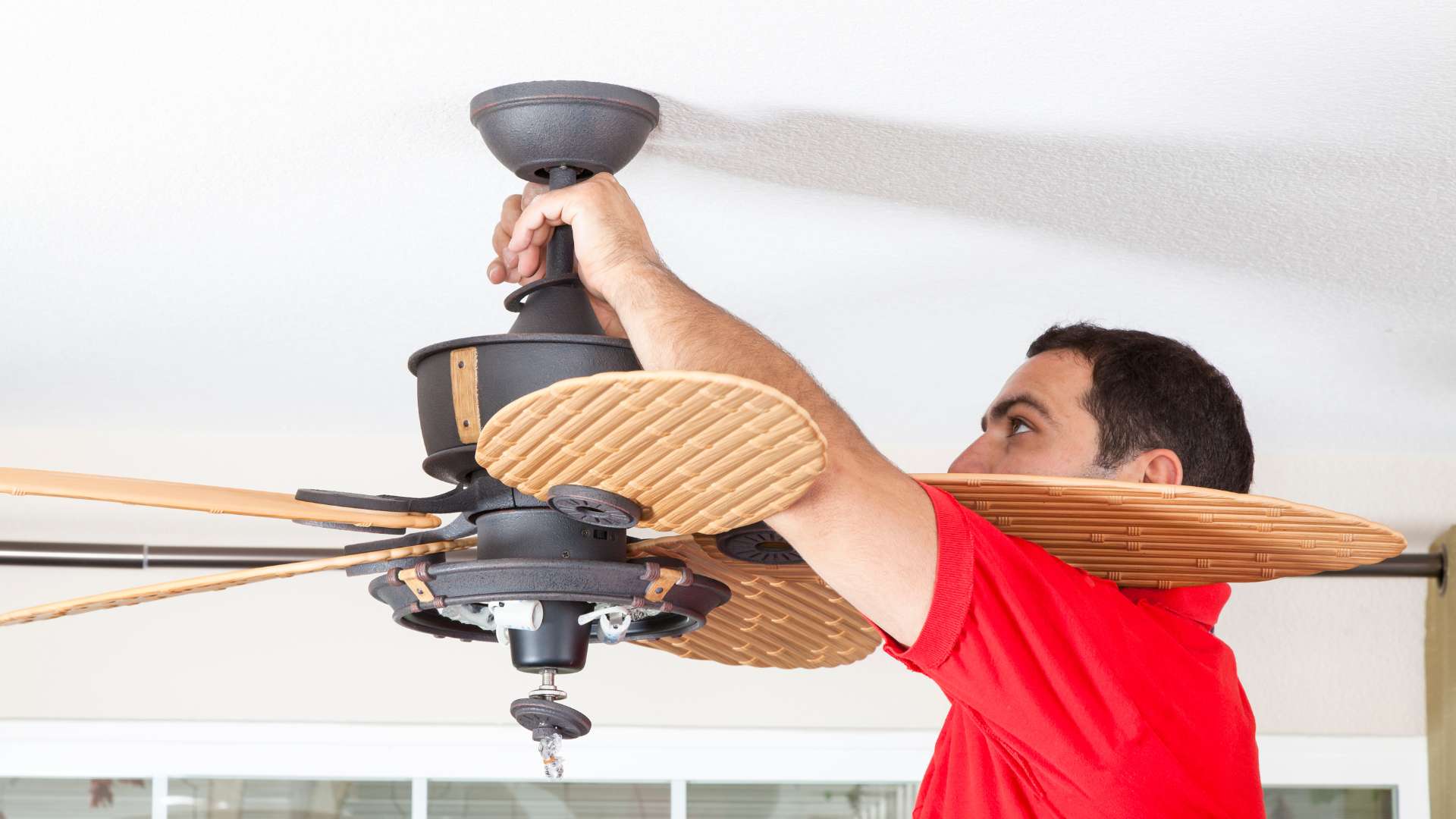
Start with the fact that undoes half the ceiling fan reviews on the internet: a ceiling fan doesn’t cool a room. It cools the person standing under it, which is a completely different product to be shopping for.
In brief
- Fans cool people, not rooms. Switch them off in an empty room.
- A US 120 V fan will not run on French mains. Check for the 230 V version.
- Hunter has made fans since 1886; Westinghouse fans come from a licensee.
- Both offer lifetime motor cover, with shorter terms on the electronics.
What a ceiling fan actually does for you
Moving air over skin speeds up evaporation, and that’s the whole trick. The US Department of Energy puts it plainly: fans cool people, not rooms, through a wind-chill effect, which is why leaving one spinning in an empty room only spends money.
The useful consequence is what it lets you do with the air conditioning, if you have any. The same source notes that a ceiling fan lets you raise the thermostat by around 4°F, roughly 2°C, with no loss of comfort, and that each degree saved trims about 1% off the cooling cost over an eight hour stretch. In a flat with no air conditioning at all, which describes a great many old buildings along this coast, the fan isn’t a supplement. It’s the entire cooling strategy, and it’s the reason shutters plus a ceiling fan can carry you through August.
The winter half of the job is less known. Reverse the direction, run it slowly, and the fan pushes the warm layer that’s collected at ceiling height back down along the walls without creating a draught. It pairs surprisingly well with the sort of portable heater I compared in my look at the Dyson Hot + Cool against the De’Longhi Dragon 4, because it stops the heat you’ve paid for from sitting uselessly above your head.
The voltage trap, and it’s an expensive one
This one deserves its own heading because it catches out English-speaking buyers constantly. American ceiling fans, including most of what you’ll see reviewed on US sites and sold on Amazon’s American store, are built for 120 V at 60 Hz. French mains is 230 V at 50 Hz. Plugging one into the other doesn’t work, and a transformer is not a sensible fix for a motor you intend to run for hours at a time.
Hunter does make 220-240 V, 50 Hz versions, and they’re explicitly labelled as not for the US market. Westinghouse products are likewise sold through European distribution in the correct specification. The rule is simple: buy from a European seller, and check the voltage line on the spec sheet before you check anything else. A beautiful fan that hums, runs slow or fails early is almost always the wrong-voltage story.
Who you’re actually buying from
The two names carry very different corporate stories, which is worth a paragraph because it explains the price gap.
Hunter has been making fans since 1886, when John Hunter and his son James built a water-driven ceiling fan in upstate New York. The company describes itself as the oldest and largest ceiling fan manufacturer in the world, and its ranges are designed and sold under its own name.
Westinghouse ceiling fans are a licensing arrangement. The trademark is managed by Westinghouse Licensing Corporation, set up in 1998 to license the historic name for non-nuclear consumer goods, and the fans and lighting are made and sold by Westinghouse Lighting Corporation, a Philadelphia family business founded in 1946 as Angelo Brothers. That isn’t a criticism, the products are perfectly respectable, but a heritage name on the canopy is not the same as an unbroken heritage of making the thing.
| Hunter Fan | Westinghouse | |
|---|---|---|
| Origin | Manufacturer since 1886 | Licensee of the Westinghouse name |
| Motor warranty | Limited lifetime | Lifetime |
| Other parts | Shorter term, often one year on electronics | Two years |
| Typical positioning | Design-led, quieter, dearer | Practical, broad choice, better value |
The five things that decide whether you like it
Once the voltage is right, these are the specifications I’d weigh, roughly in order of how much regret they cause.
1. Blade span against room size
A fan too small for the room moves air in a narrow column and does nothing at the edges. Bedrooms and average living rooms are usually the 44 to 52 inch territory that models like Hunter’s Builder Deluxe or the Westinghouse Comet occupy. A small study or a balcony nook is where a compact model such as the Westinghouse Quince makes sense. Match the sweep to the floor area rather than to the look.
2. Ceiling height and how it mounts
Old apartments here often have generous ceilings, in which case a downrod brings the blades to a useful height. Modern flats frequently don’t, and that’s the case for a low-profile or flush mount like Hunter’s Dempsey. Blades should clear your head with room to spare, and stay well away from the wall.
3. AC or DC motor
DC motors draw less power, run quieter and usually offer more speed steps, at a higher purchase price. On a fan you run for weeks at a stretch in July and August, that trade pays for itself in sleep as much as in electricity.
4. The light kit
Integrated LED is tidy and efficient, but when it fails you’re often replacing the whole fixture rather than a bulb. A traditional light kit that takes standard bulbs is more repairable. Decide which of those two futures you prefer before you buy, not after.
5. How you’ll control it
A pull chain is reliable and free. A remote is convenient until it’s lost, and remote receivers are typically the first thing to fail and the part with the shortest warranty. Wall control is the tidiest answer if the wiring allows it. Small features do earn their place: Hunter’s Dust Armor blade coating, for instance, means fewer trips up the ladder with a cloth, which in a coastal flat with the windows open is not nothing.
Fitting one is electrical work, not decorating
A ceiling fan weighs several kilos and it moves, which is a different load from a light fitting. Two rules I’d never bend.
First, the fixing has to be rated for a fan. A standard ceiling rose or plasterboard box is designed to hold a static lamp, not a spinning mass that vibrates for years. That means a proper fan-rated mount fixed into the structure, not into the plasterboard alone.
Second, the connection is subject to French wiring rules, NF C 15-100, like any other fixed installation. If you’re at all unsure about the circuit, the earthing or the state of the wiring in an older building, this is a job for a qualified electrician. It’s an hour of someone’s time against a fan coming down on a bed.
Before you click buy
Which brand is quieter? Motor type tells you more than the badge. A DC motor fan from either maker will generally beat an AC one, and a fan that wobbles is a balance or mounting problem rather than a brand problem.
Are they energy efficient? Both ranges include efficient models, some carrying an Energy Star rating on the US market. Any ceiling fan uses a fraction of what air conditioning does, which is rather the point.
Which is easier to install? Both are designed for straightforward assembly, and both ship with clear instructions. The variable is your ceiling, not the box.
Can I use one outdoors on a terrace? Only a model rated for damp or wet locations. An indoor fan on a covered terrace by the sea will corrode, and quickly. Salt air is unforgiving about this.
Skipping the fan’s light kit?
Then the room needs a proper lighting plan instead.