
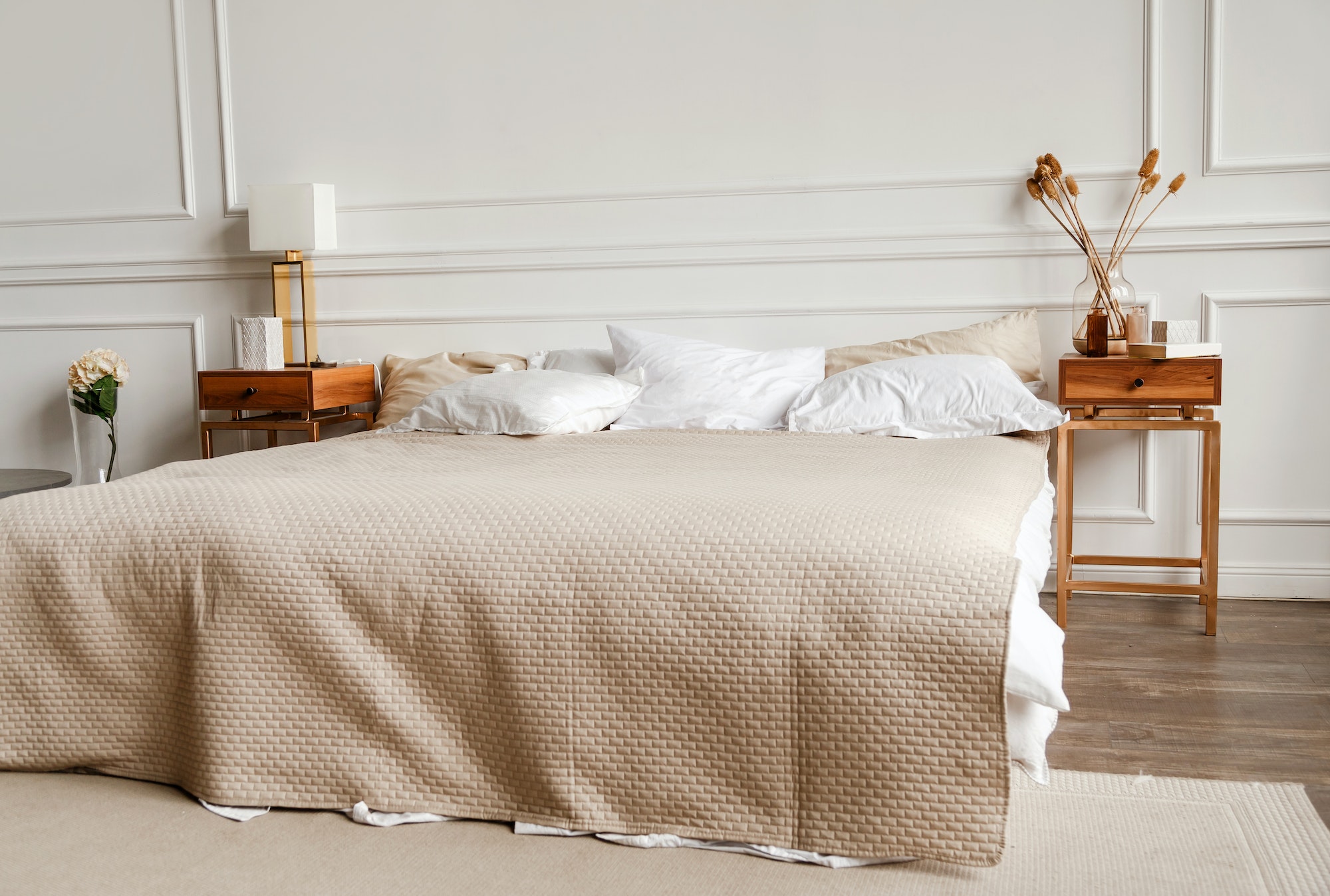
Most bedroom makeovers billed as costing under 100 dollars quietly add up to nearer two hundred by the last paragraph. The trick is not finding cheaper things to buy, it is deciding in advance which two or three surfaces actually carry the room.
In brief
- Empty and rearrange the room before buying a thing.
- Bedding and lighting change a room more than art does.
- Keep a written running total or the budget will drift.
- Check the CE mark on any electrical item you plug in.
Day one costs nothing and does the most
Before any order goes in, strip the room back. Everything off the surfaces, everything out from under the bed, the wardrobe emptied onto the floor and sorted into keep, give away, throw away. It is the least glamorous stage and it produces the biggest visual change of the whole project, because clutter is what makes a room read as tired.
While the floor is clear, try the bed somewhere else. Moving the bed to face the door, or turning it to catch morning light from a different angle, changes the proportions of a small room in a way no cushion ever will. Wash the windows and the paintwork at the same time. Southern light is unforgiving on both, and a clean window transforms the colour of everything in the room.
My allocation, and where I would flex it
Here is how I split a 100 dollar budget when a room needs to look different by Sunday evening. The proportions are the point rather than the exact figures: prices move constantly and vary a lot between countries and retailers, so treat the right hand column as a spending ceiling to respect, not a price I am promising you.
| What | Why it earns its place | Ceiling |
|---|---|---|
| Bedding set | Largest surface in the room and the one you touch every night | 40 |
| Light: LED strip or a warm bulb swap | Changes the mood of the room after dark more than any object | 25 |
| Two or three cushions | Adds texture and ties the new bedding to what you already own | 20 |
| One focal point on the wall | Gives the eye somewhere to land opposite the door | 15 |
| Declutter, rearrange, deep clean | The single biggest change in the room | 0 |
The discipline is the running total. Write the four ceilings on a piece of paper, note what you actually spend next to each, and refuse to move money between lines except downwards. Every over budget makeover I have watched went wrong in exactly the same way: one item came in a little dearer, and that became permission for the next three to do the same.
Lighting: the cheapest lever in the room
An LED strip is the accessory that gives the most theatre for the money. Choose the colour changing version rather than a single colour, because the room you want in six months will not be the room you want tonight. The kit normally arrives with an adhesive backing, a controller and a power supply.
Fit it along a line the room already has: the top of a wardrobe, behind the headboard, under a floating shelf, along a picture rail. Hidden strips look designed, visible strips look like a strip. Clean and dry the surface before peeling the backing, because dusty paint is why half of them sag within a fortnight.
Two practical points on anything electrical. Check the CE mark, which is compulsory on electrical equipment sold in the European Union, and keep the strip and its transformer clear of bedding, curtains and rugs so nothing traps the heat. If you would rather change the quality of the light than add a new source, swapping cold bulbs for warm ones costs less and does more, and there is a real difference between smart lighting systems if you go that route: I compared Philips Hue and LIFX for interior lighting when I set mine up.
Textiles carry the room, and they are what you feel
Bedding is the biggest single expanse of colour in a bedroom, so it decides the palette whether you plan it or not. Pick it first, then let the cushions and anything on the walls follow, rather than the reverse. Plain sets with texture age better than bold prints, and they survive being mixed with whatever you already own.
Cushions are the cheap way to add texture: mix a smooth weave with something ribbed or knitted rather than matching everything. If you can sew even slightly, covers made from a metre of remnant fabric cost a fraction of finished ones, and the method is simple enough for a first attempt.
Scent, and an honest word about diffusers
An essential oil diffuser is a pleasant, genuinely inexpensive addition, and it belongs in the optional column rather than the core budget. What I would not repeat are the health claims that follow these devices around: a scented room can feel calmer, but that is comfort, not medicine, and the specific benefits often listed for individual oils are not established.
There is also a real safety point if you have animals. The ASPCA warns that oils including tea tree, eucalyptus, peppermint, citrus and pine can cause problems for pets, that a diffuser used briefly in a room a pet cannot access is unlikely to be an issue, and that diffusers should be avoided entirely around birds and around any animal with respiratory problems. In a bedroom where a cat sleeps, that settles the question for me.
The wall, last and cheapest
One focal point beats a scattering of small frames, especially in a small room. A large piece of fabric stretched on a frame, a single oversized print, a mirror rescued from a brocante and repainted: any of those anchors the wall opposite the door for very little.
If the budget is spent and the wall is still bare, that is fine. A room that is clean, uncluttered, warmly lit and freshly dressed already reads as made over. The blank wall becomes next month’s small project rather than this month’s overspend.
Still have a bare wall behind the bed?
A homemade headboard is the one addition that changes a bedroom out of all proportion to what it costs.
Published on 18 August 2026. Source consulted in August 2026: ASPCA, The Essentials of Essential Oils Around Pets.