The romantic part of building with reclaimed wood lasts about an hour. Then you are standing in front of a stack of boards of six different thicknesses, two of them painted something suspicious, wondering which ones deserve to come into the house.
In brief
- Read the pallet stamp: HT is safe indoors, MB is not.
- Never dry sand unknown paint on anything from a pre 1949 building.
- Design around the material you have, not the drawing you made.
- Anchor the finished unit to the wall, whatever it weighs.
What I take, and what I leave on the pavement
Free wood stops being a bargain the moment it ruins a blade or brings something living into your flat. My sorting is quick and fairly ruthless.
Worth taking: pallet boards carrying a clear IPPC stamp with the letters HT, which means the wood was heated to a core temperature of 56°C for at least thirty minutes with no chemicals involved. Old scaffold boards, once checked for grit. Solid drawer sides and cupboard backs from broken furniture, which are often better timber than anything sold today. Offcuts from a building site, with permission, and preferably before the rain gets to them.
Left where it is: anything stamped MB, meaning methyl bromide fumigation, which the EU banned for this use in 2010 and which has no place in a bedroom. Pallets with no marking at all, or with stains of unknown origin. Wood with the small round exit holes and fine dust of active woodworm. And chipboard that has been damp, which never really comes back.
The stamp, incidentally, appears on at least two opposite sides of a compliant pallet, usually on the stringers. If you can only find it on one face, look again before assuming there isn’t one.
The paint question, which is not optional
Old painted timber is the one place where enthusiasm needs to stop. Lead based paint was in ordinary domestic use for a very long time, and sanding it dry turns it into a dust you cannot see and should not breathe. The regulatory dates give you a usable rule of thumb: in France the lead risk assessment known as the CREP is required for housing built before 1949, and in the United States the EPA treats homes built before 1978 as presumed to contain lead paint.
So if a board came out of a building older than that and carries paint you cannot identify, either leave the paint alone and design around it, or have it dealt with properly. Dry sanding is the one thing not to do. Honestly, chipped original paint left visible is the better looking option anyway.
Getting mixed material to agree with itself
This is the step that turns a pile into a unit, and it is where most first attempts go sideways. Reclaimed boards are rarely the same thickness, almost never square, and frequently cupped.
- Pull every nail and screw first, then run a magnet over each board. One buried brad head will take the edge off a blade in a second.
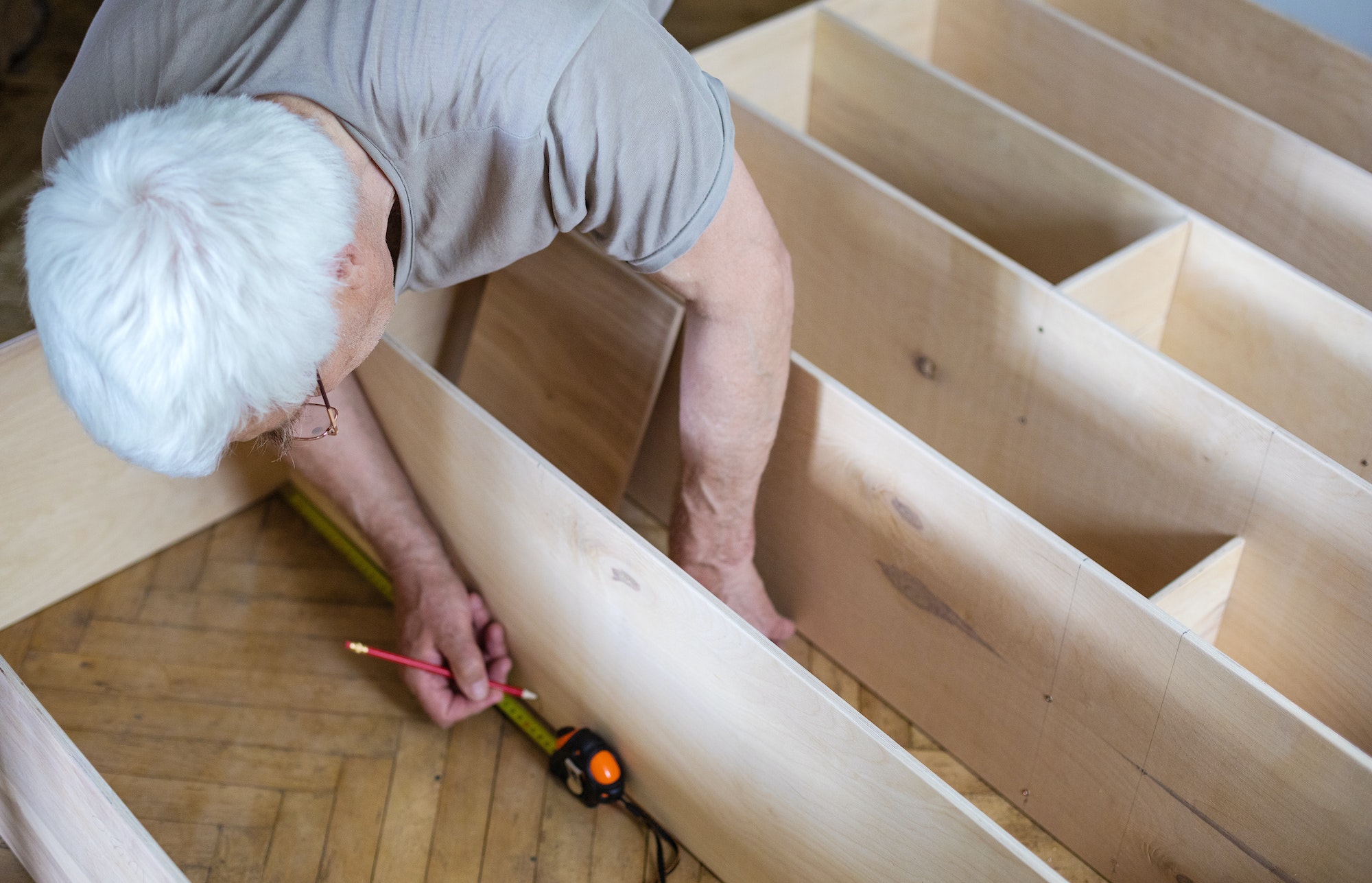
- Pick a reference thickness from the thinnest usable board and bring the others down to it, or accept the variation and hide it by keeping all the visible faces in one plane and letting the backs run wild.
- Establish one straight edge per board before any other cut. Every measurement afterwards refers to it.
- Sand progressively, and stop before the wood loses its history. The point of reclaimed material is the grain and the patina, not a factory finish.
- Cut the joints last, once you know the real dimensions rather than the ones in your sketch.
Assembly that suits imperfect timber
Half lap joints, where each piece loses half its thickness so the two sit flush, forgive small differences far better than a butt joint and a screw. They also give you a mechanical shoulder that takes the load rather than relying on the fastener alone.
Countersink every screw head below the surface and fill or plug it. On boards of uneven thickness, set the depth from the visible face rather than the back, so the front of the unit reads as one clean plane even when the carcass behind it does not. If the finished unit is large, build it as sections that bolt together on site: reclaimed timber is heavy, and a one piece bookcase that will not go round the turn of a Niçois staircase is a lesson you only need once.
Then anchor it. Every tall storage unit gets fixed to the wall, no exceptions, and reclaimed builds especially because their weight is rarely where you think it is. Which fixing depends entirely on what the wall is made of, and in the old buildings along this coast that is usually hollow brick rather than anything solid.
Why bother, beyond the look
The environmental case is real and simple: a board reused is a board not manufactured and not landfilled. But the honest reason most people keep doing it is the other one. Reclaimed timber carries marks that no finish can imitate, and a shelf made from the sides of a broken wardrobe has a story that an assembled flat pack never will.
Is it actually cheaper? The material is free or nearly. The time is not, and you will spend more of it on preparation than on building. Worth it for a feature piece, less so if you need six identical units.
Can I use it in a bathroom or a kitchen? Reclaimed solid wood, with a suitable finish, sometimes. Reclaimed panel products, no. They were never designed for humidity and they will not survive it.
Measure twice, cut once, and let the imperfections show. The alternative is spending a weekend making free wood look like something you could have bought.
Another way to use a stack of pallets
The same stamps, the same sorting rules, a very different piece of furniture.
Updated 17 August 2026. Sources consulted: ISPM 15 treatment and marking requirements (IPPC), including the HT core temperature of 56°C for 30 minutes and the EU ban on methyl bromide for wood packaging from 2010; French rules on the constat de risque d’exposition au plomb for housing built before 1949; United States Environmental Protection Agency guidance on renovation in homes built before 1978. Safety information is general: if you suspect lead paint, have it assessed rather than sanded.