Anthracite grey. That is what nine out of ten aluminium patio covers along this coast end up being, and half the owners chose it because the brochure opened on that page. It is a perfectly good colour. It is also, on a south-facing terrace in July, the one that behaves worst.
In brief
- Match the frames and the shutters before matching the walls.
- Dark surfaces in full sun run far hotter than pale ones.
- On the coast, ask for a Qualimarine lacquering.
- Above 5 m², a French planning formality applies.
Start from what you cannot repaint
A patio cover is not a piece of furniture you can swap out, so the colour has to answer to everything around it that is equally permanent.
Walk the terrace and list what is fixed: the roof tiles, the shutters, the window and door frames, the decking or paving, the garden wall. Those are your constraints. The render on the house is the least constraining of the lot, because render gets repainted every fifteen years or so and shutters and joinery rarely do. Matching the aluminium to the window frames is almost always the safer decision, and it is the one people regret least.
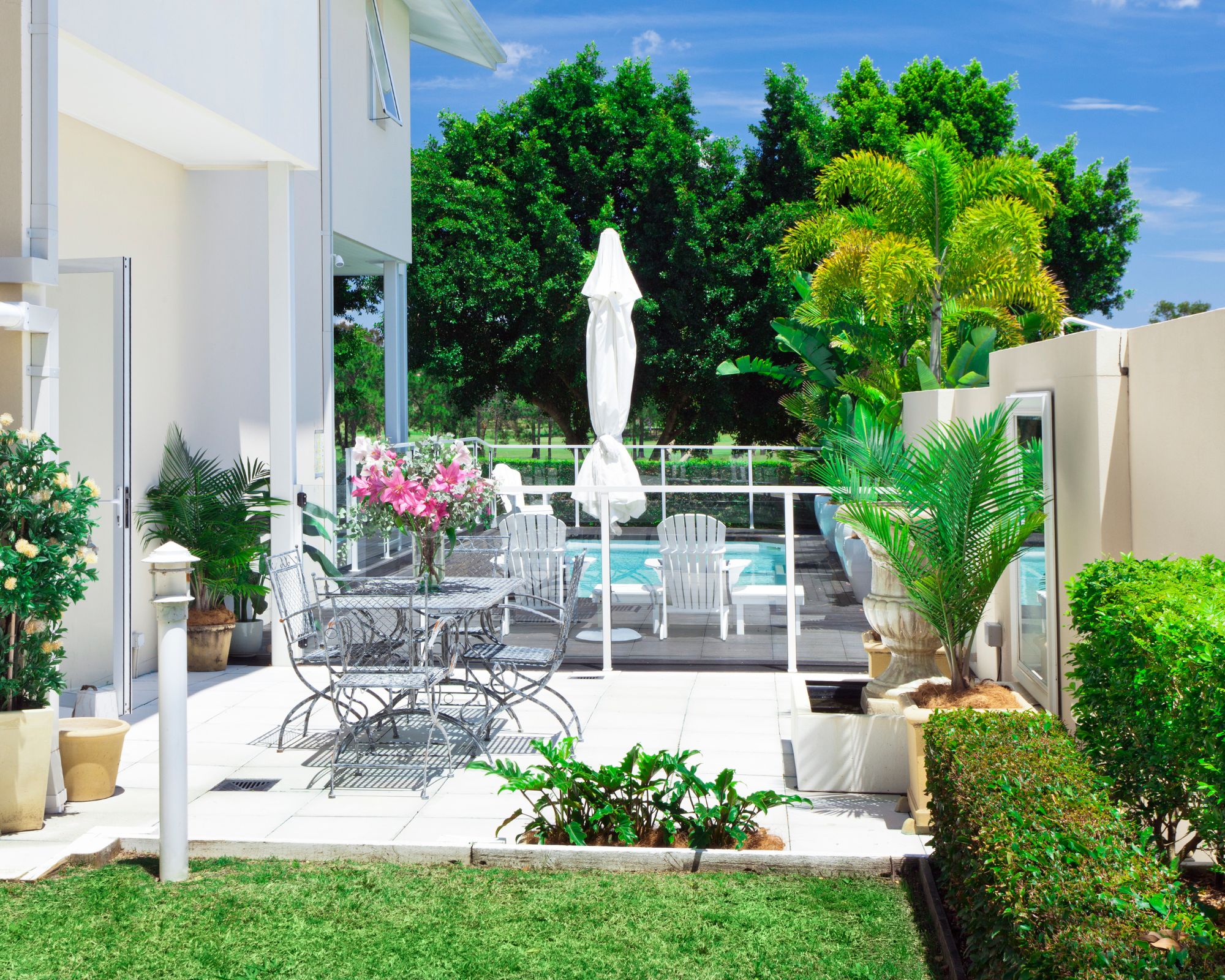
Underfoot matters just as much. Grey aluminium over grey composite decking reads as flat and slightly industrial; the same grey over warm terracotta tiles reads as deliberate. If your decking and your structure clash, you will notice it every single day, because the two are in your field of vision at the same time. That is also where the render comes back into play: think about how the tone sits against the foundation plaster at the base of the wall, which is usually darker and coarser than the wall above it.
The heat question nobody mentions in the showroom
Dark colours get hot, and on an aluminium structure in full Mediterranean sun that is not a detail.
The physics is well documented in the coatings literature: a highly absorbing surface such as conventional black paint can sit as much as 50 °C above air temperature in sunlight, while a solar reflective white finish is limited to roughly 10 °C above ambient, according to research published on cool coatings for coil coated aluminium (Solar Energy Materials and Solar Cells, 2019). Anthracite falls closer to the black end of that range than to the white.
What that changes in practice depends on the structure. On an open pergola with blades, a hot frame is mostly a problem when you touch it. On a closed patio cover with a solid roof, the frame radiates into the space you were trying to keep cool. A south or west facing terrace with no shade tree is the case where a mid tone or a pale finish genuinely earns its place.
On the coast, the lacquering outranks the colour
Within a kilometre or two of the sea, the finish specification is what decides whether your colour still looks like itself in ten years.
Aluminium does not rust, since there is no iron in it, and it forms its own protective oxide layer. But salt-laden air attacks the interface between the metal and the lacquer, which shows up as filiform corrosion creeping out from edges and screw holes. The industry answer is a reinforced chemical pretreatment before the powder coating goes on.
Two labels are worth naming when you ask for a quote. Qualicoat certifies the lacquering process itself: coating thickness, adhesion, mechanical resistance. Qualimarine, issued by ADAL and created in 2001, goes further and covers the reinforced pretreatment intended for coastal and heavily polluted industrial atmospheres. If you live where you can smell the sea, ask for the second one in writing, on the quote, not as a verbal reassurance.
One more practical point: the recycled credentials of aluminium are real. Recycling it uses around 95% less energy than producing primary aluminium, according to the International Aluminium Institute. That argument holds whatever colour you pick, so it is not a reason to choose one shade over another.
Matching or contrasting: a short honest guide
Both work. The failures I have seen come from choosing contrast by accident rather than on purpose.
| Setting | Colour that usually works | Why |
|---|---|---|
| Pale render, lots of greenery | Off-white, sand, pale grey | Keeps the planting as the subject |
| White house, minimal garden | Full contrast, black or dark grey | The structure becomes a graphic line |
| Ochre or terracotta façade | Warm bronze, taupe, deep green | Stays in the same warm family |
| South or west terrace, no shade | Mid to pale tones | Limits heat radiating off the frame |
| Flat overlooked by neighbours | Whatever the co-ownership allows | The rules decide before you do |
If you want contrast, make it total rather than approximate. A black structure against a white house is a decision. A slightly different grey against an existing grey looks like a colour that was ordered wrong.
Before you order: the paperwork
In France a patio cover or pergola is a construction, and the surface it covers decides the formality.
- Under 5 m² of ground footprint: no planning formality.
- Between 5 and 20 m²: a déclaration préalable de travaux at the mairie.
- Above 20 m²: a permis de construire. The threshold rises to 40 m² for an extension attached to an existing building in a zone U covered by a PLU, under article R421-14 of the Code de l’urbanisme.
- Once the total floor area after works passes 150 m², an architect becomes compulsory (article R431-2).
Two local traps on top of that. A PLU or a protected area can impose a restricted palette of authorised colours, which settles the question for you. And in a copropriété, altering the appearance of the façade or a private terrace normally requires a vote at the general meeting, whatever the mairie says.
Three things people ask me afterwards
Can a lacquered aluminium patio cover be repainted later? Technically yes, with a specific primer for aluminium, and it will never match a factory finish for durability. Treat the original colour as permanent and choose accordingly.
Does a pale colour show dirt more? Less than people expect. What shows on a pale finish is organic staining under trees; what shows on anthracite is dust, pollen and dried salt spray, and near the sea that is the more frequent nuisance.
Should the roof panels match the frame? Not necessarily. A frame in one tone with clear or opal polycarbonate is common and lets far more light into the room behind, which on a north facing terrace matters more than the colour debate does.
The version I would give a neighbour over the hedge: take a sample of the lacquered aluminium home, hold it against the shutters at eleven in the morning and again at six in the evening, and only then sign. Colour charts are lit by shop ceilings. Your terrace is not.
Bringing the same colour logic indoors?
The rules change once you are the one holding the roller, and so does the maths on what it costs.