
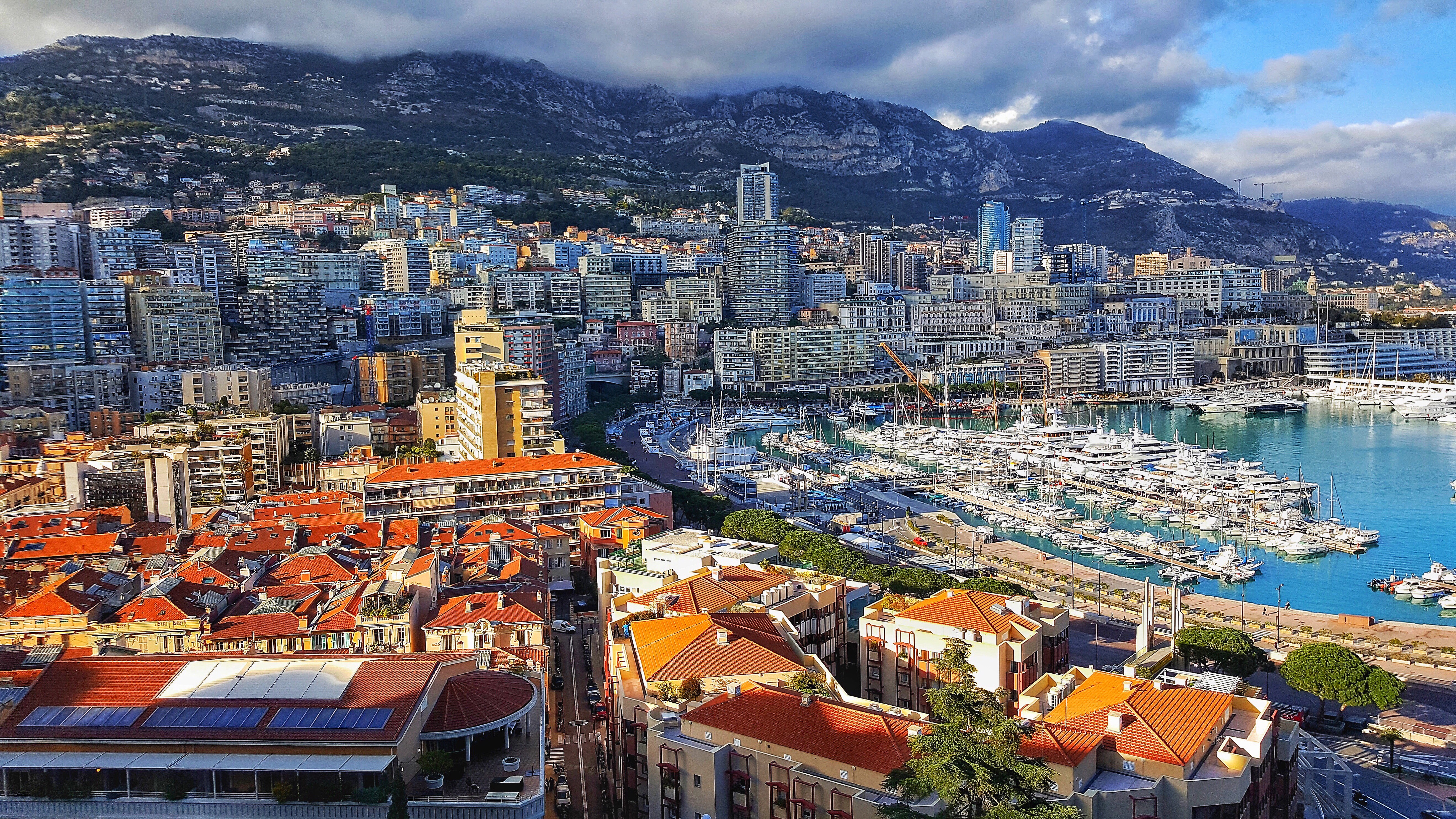
I take the coastal train from Nice to Monaco often enough that I stopped noticing the skyline, until a friend visiting from London asked why half the Principality looks like an opera house and the other half looks like a spreadsheet. It is a fair question, and the answer explains most of what happens to property prices here.
In brief
- The Prince’s Palace revealed 600 m² of 16th century frescoes after ten years of work.
- Charles Garnier’s Salle Garnier opened in 1879, in about eight and a half months.
- The Tour Odeon rises 170 m over 49 floors, delivered in 2015.
- Mareterra added roughly six hectares to the country in December 2024.
- 1 The rock, the fortress, and ten years of scaffolding
- 2 The casino is not one building, and it is not one period
- 3 Two buildings most day trippers walk straight past
- 4 When land runs out, buildings go up
- 5 Mareterra: six hectares that did not exist a decade ago
- 6 What the buildings tell you about the market
The rock, the fortress, and ten years of scaffolding
Everything starts on Le Rocher, the promontory where the old town sits. The Prince’s Palace began as a fortified position whose origins are traced to the end of the twelfth century, and it stayed a fortress long after other European courts had moved into palaces. What turned it into a residence was the second quarter of the sixteenth century, when Augustin and Étienne Grimaldi rebuilt the old castle in the Renaissance manner after the Genoese siege of 1506 and 1507.
Then it disappeared under plaster. A restoration campaign that ran for about ten years uncovered roughly 600 square metres of sixteenth century frescoes that had been invisible for centuries, cleaned with a laser technique developed for the project and retouched in watercolour. The rooms reopened to visitors in 2023, and if you only have one hour in Monaco, spend it there rather than at the harbour. Very few people expect a Renaissance painted ceiling in a country better known for its Grand Prix.
The casino is not one building, and it is not one period
The Monte Carlo Casino gets described as a Belle Epoque masterpiece, which is a convenient shorthand and slightly wrong. The complex grew in stages across several decades, and its most famous element, the Salle Garnier, opened in 1879 to a design by Charles Garnier, the architect of the Paris opera house.
The detail I like best is the pace. Garnier’s Paris opera took from 1861 to 1875. The Monaco hall, seating 524 against roughly two thousand in Paris, went up in about eight and a half months. It was commissioned under Prince Charles III with the Société des Bains de Mer, in a country that at that point had almost no cultural venues at all. Monaco has been building fast, on constrained ground, for a very long time.
Two buildings most day trippers walk straight past
The Oceanographic Museum
Prince Albert I, the sailor prince, laid the first stone on 25 April 1899 and inaugurated the Oceanographic Museum on 29 March 1910. It stands on the cliff face, and the point of it is not the aquarium but the gesture: a neo-baroque monument built into a rock wall to house the study of the sea. From the terrace you get the view that every photograph of Monaco is trying and failing to reproduce.
The cathedral
The Notre Dame Immaculate Conception cathedral was built between 1875 and 1878 in white stone from La Turbie, the village just above the border. It is the quietest building on the Rock and the one that tells you the most about local materials, since that same pale limestone runs through the older facades of the whole coastline.
When land runs out, buildings go up
By the late twentieth century the horizontal options were gone, and the Principality went vertical. The Tour Odeon, designed by architect Alexandre Giraldi and delivered in 2015, rises 170 metres over 49 floors, which makes it the tallest building in the country. On completion it was reported as the second tallest on Europe’s Mediterranean coastline, behind the Gran Hotel Bali in Benidorm at 186 metres.
What a tower does to a market is straightforward. It multiplies the number of apartments with an unobstructed sea view, and sea view is the variable that dominates value here far more than floor area or fittings.
| Landmark | Date | Behind it | What to look at |
|---|---|---|---|
| Prince’s Palace | 12th c. fortress, 16th c. palace | The Grimaldi family | The rediscovered frescoes |
| Salle Garnier, Monte Carlo Casino | 1879 | Charles Garnier | The scale, deliberately intimate |
| Notre Dame Immaculate Conception | 1875 to 1878 | Diocese of Monaco | The white La Turbie stone |
| Oceanographic Museum | 1899 to 1910 | Prince Albert I | The cliff facade from the sea |
| Tour Odeon | 2015 | Alexandre Giraldi | 170 m, 49 floors |
| Mareterra, former Portier Cove | Inaugurated 4 December 2024 | Renzo Piano, Valode & Pistre, Michel Desvigne | The public promenade, free to walk |
Mareterra: six hectares that did not exist a decade ago
The land reclamation project long known as Portier Cove was inaugurated under the name Mareterra on 4 December 2024. It adds roughly six hectares, more than three per cent of the country’s surface, with the maritime structure completed back in December 2019 and construction running through to delivery.
The design team brought together the Renzo Piano Building Workshop, Valode & Pistre and landscape architect Michel Desvigne, with Foster + Partners also credited on the project. Agencies operating in the district report a private programme of around 110 apartments, ten villas and four townhouses, alongside a small marina, roughly 500 metres of coastal walk and around a thousand mature trees. Those private figures come from commercial sources rather than an official register, so treat them as an order of magnitude.
The part that concerns everyone, including those of us who will never live there, is public. The promenade and the landscaped hill are open, and they are the pleasant surprise of the whole operation: a district built for a very small number of residents that gave the rest of the coast a genuinely good walk.
What the buildings tell you about the market
Scarcity is not an abstraction here, it is the ground itself. According to the Observatoire de l’immobilier published in February 2026 by IMSEE, the Monegasque statistics institute, the average price across 2025 transactions reached 57,569 euros per square metre, with Larvotto passing 71,000 euros. Those numbers are the direct consequence of a country that can only grow by restoring, stacking or reclaiming.
One correction to a line you will read everywhere, including in the older version of this article. Calling Monaco a tax haven is a shortcut that has aged badly. Residents are not liable for income tax, with the notable exception of French nationals, who are governed by the Franco-Monegasque convention of 18 May 1963. And since June 2024 the Principality has been on the FATF grey list, under an agreed action plan, which is the opposite of an unregulated jurisdiction. If you are looking seriously at the market, the practical framework matters more than the reputation, and I set it out in more detail in my piece on buying or selling a property in Monaco.
Planning more than a day trip?
The intermediary you pick shapes what you are shown, here more than anywhere.
Updated 14 August 2026. Sources consulted: the Prince’s Palace restoration and fresco campaign as documented by the Palace and the Monegasque press; the Opéra de Monte-Carlo and Salle Garnier chronology; the Oceanographic Museum’s own foundation dates; the Tour Odeon project documentation; the Mareterra project communications for the December 2024 inauguration and design team; IMSEE, Observatoire de l’immobilier published February 2026 for the 2025 prices; the Monegasque government for the Franco-Monegasque tax convention of 1963 and for the FATF listing of June 2024. General information only, not investment advice.