Home made furniture rarely fails at the joint. It fails a season later, when the wood swells in an August kitchen and the joint that was supposed to hold it still simply splits the board instead.
In brief
- Wood shrinks across the grain roughly twice as much tangentially as radially.
- Solid wood, plywood and MDF fail in three completely different ways.
- From 6 August 2026 EU furniture faces a stricter formaldehyde limit.
- Finish the parts before assembly, not the assembled piece afterwards.
Wood never stops moving, and your design has to allow it
This is the rule that separates furniture which lasts from furniture which cracks, and almost nobody mentions it in a beginner’s tutorial. Timber takes up and gives off moisture until it balances with the air around it, settling around 12% moisture content at roughly 65% relative humidity. On the coast that figure swings hard between a shuttered winter flat and a July afternoon with the windows open.
What matters is that the movement is not even. Shrinkage in the tangential direction, around the growth rings, runs to about twice the radial figure. European beech, to take a common cabinet timber, is quoted by the Wood Database at 11.7% tangential against 5.8% radial. A solid panel 400 mm wide will visibly change width across a year and will not change length at all.
So the design rule is simple: never trap a wide solid panel. Fix a tabletop with buttons or slotted screw holes rather than glued blocks, let a solid door panel float inside its frame, and avoid gluing a wide board across the grain of another. If two pieces are going to argue about the weather, make sure one of them is allowed to win.
Solid wood, plywood or MDF
Each material is the right answer to a different question, and the failure modes are what should decide you rather than the price per sheet.
| Material | Best for | How it lets you down |
|---|---|---|
| Solid wood | Frames, legs, rails, anything that will be repaired or refinished in twenty years | Splits when its movement is blocked; costs the most |
| Plywood | Large stable panels, carcasses, shelves | Raw edges look unfinished without lipping or edge banding |
| MDF | Painted parts, doors, anything needing a perfectly flat surface | Heavy, holds screws badly in the edge, sags over a long span |
Two points worth knowing before you load a trolley. Chipboard and MDF sold as moisture resistant are covered by EN 312 P3 and EN 622-5 respectively, which describes a humid environment rather than a waterproof one: a cut edge or a tap hole is still the weak point. And from 6 August 2026, under Commission Regulation (EU) 2023/1464, furniture and wood based articles placed on the EU market must stay under a formaldehyde emission limit of 0.062 mg/m³, half the value usually quoted as the E1 reference. If you are buying panels for a bedroom, that number is now worth reading on the label.
Joinery: three joints, three jobs
You do not need a repertoire. You need to know which of three does what.
- Mortise and tenon, a tongue fitted into a matching cavity, is the frame joint. It resists a leg being racked sideways, which is the load that eventually loosens every table and chair.
- Dovetail, with its interlocking wedges, resists being pulled apart along one axis. That is exactly the load on a drawer front every time someone yanks it open, which is why it lives there.
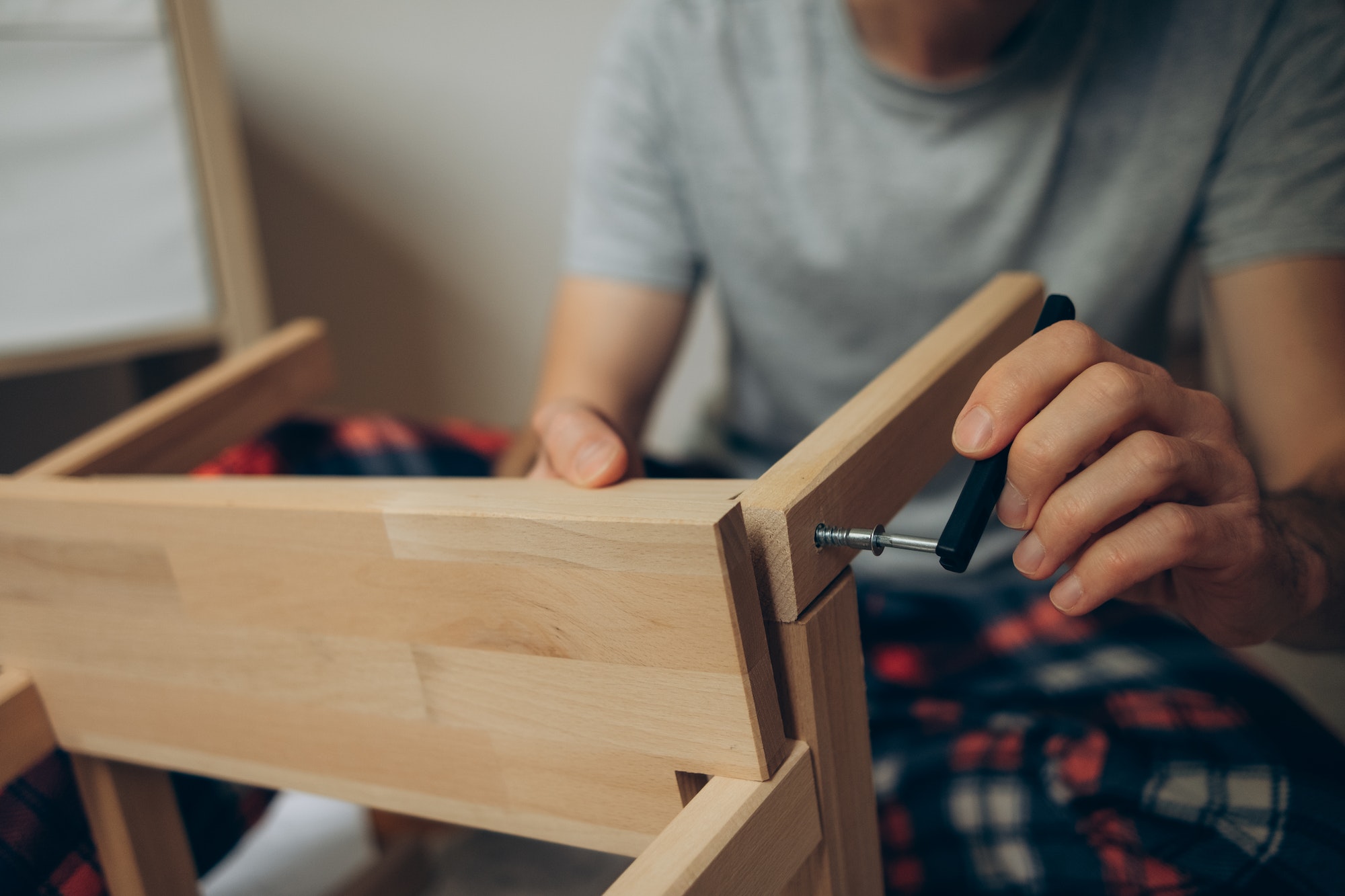
- Pocket hole, an angled hole and a screw, is fast and perfectly honest for a carcass or a hidden rail. It is a clamping joint rather than an interlocking one, so keep it away from anything that racks.
Hardware follows the same logic. Drawer runners and hinges are specified for a weight and a panel thickness, and MDF holds a screw poorly through its cut edge, so plan inserts or a solid wood lipping where the hardware lands.
The order of work that saves the project
- Cut and dimension every component, checking that matching parts are identical rather than merely correct.
- Cut the joinery, aiming for a fit that needs hand pressure, not a mallet.
- Dry fit the whole piece, clamped, with no glue anywhere. This is the last moment a mistake is free.
- Sand and finish the parts while they are still separate, masking the glue surfaces. Finishing a built cabinet from the inside is a job you only do once before learning this.
- Glue up, clamp, then fit the hardware once everything has cured.
Plans, a photograph, or your own sketch
All three routes work, and they suit different temperaments. Published plans remove every dimension decision, which for a first build is a gift rather than a limitation. Working from a photograph means reverse engineering the sizes: pick one known element in the image, a standard seat height or a door, and scale everything else from it. Designing from scratch is where a scale drawing or a quick model in something like SketchUp earns its keep, because a proportion that looks wrong on paper looks worse in oak.
Whichever you choose, write the cutting list before you buy timber. It is the cheapest quality control step in the whole process.
Two things people ask me
What should a first piece be? Something with four straight legs and no drawers. A simple side table teaches frame joinery, wood movement and finishing in a weekend, and if it goes wrong you have lost one board.
How thick should a shelf be? That depends entirely on how far it spans, and it is the calculation that catches everyone out. I went through the numbers separately in my notes on how far a shelf can span before it sags.
Take your time on the dry fit and be patient with the finish. The piece that survives twenty years is almost never the most ambitious one, it is the one whose maker allowed the wood to breathe.
Prefer to build from what already exists?
Reclaimed boards bring their own rules, their own charm and their own hazards.
Updated 17 August 2026. Sources consulted: Wood Database species data for European beech shrinkage and hardness; forestry extension guidance on equilibrium moisture content and tangential against radial shrinkage; standards EN 312 (particleboard) and EN 622-5 (fibreboard) for moisture resistant grades; Commission Regulation (EU) 2023/1464 amending Annex XVII of REACH, applicable from 6 August 2026, for the formaldehyde emission limit. Figures are for guidance: check the technical data sheet of the exact board and hardware you buy.