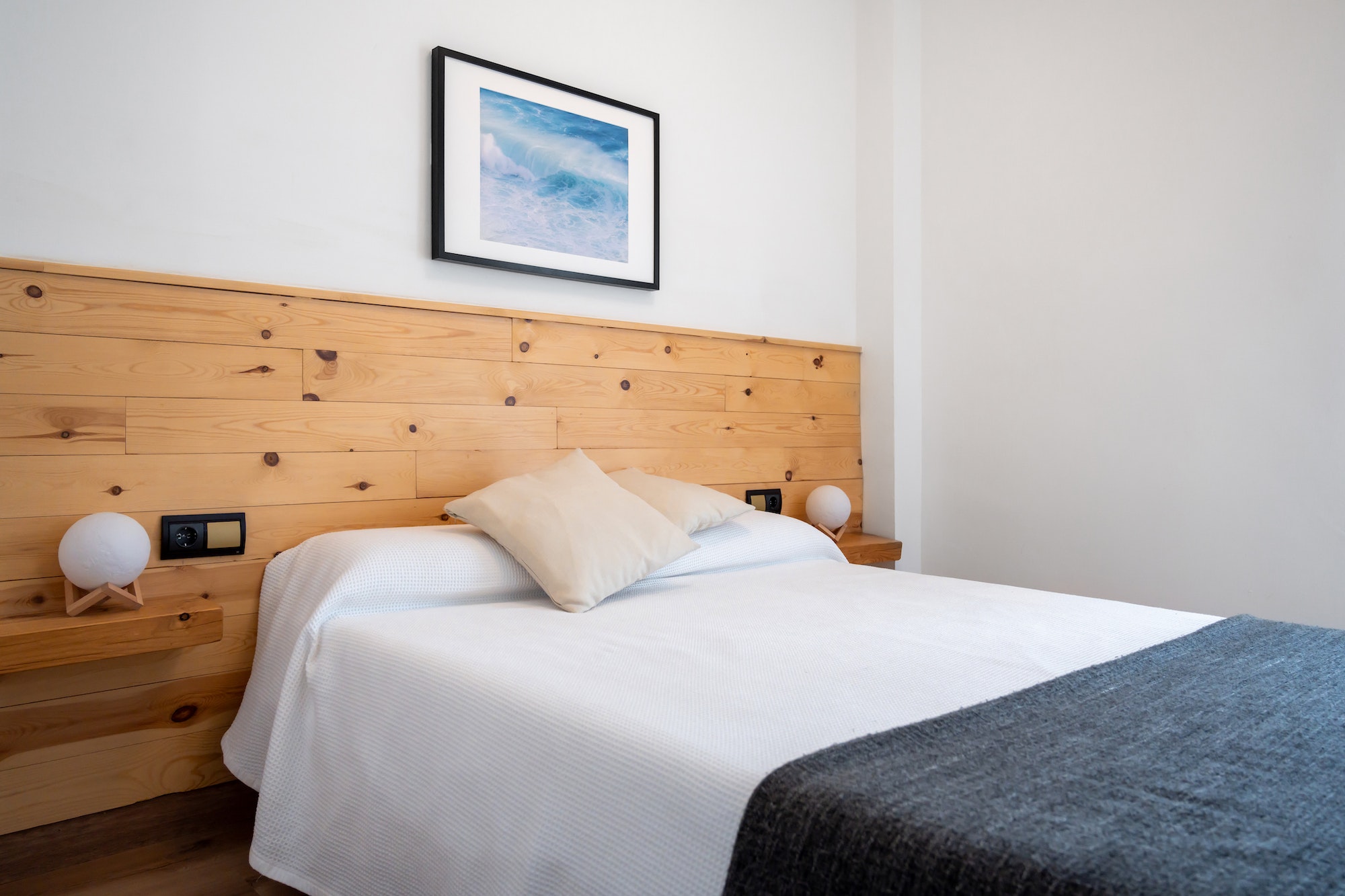
Half the bedrooms I get asked about are in rented flats, which means the wall behind the bed is off limits, or nearly. That constraint turns out to be a gift: it rules out the expensive route straight away and pushes you towards the headboards that actually look handmade in a good way.
In brief
- Only reuse pallets stamped HT, never those stamped MB.
- Measure the height from the top of the mattress, not the floor.
- A leaning headboard needs one anti-tip fixing, not a full mount.
- High density foam of 2.5 to 5 cm is the useful range for tufting.
The four routes, side by side
Before any cutting, it helps to see how differently these options behave once they are in a room. The last column is the one renters should read first.
| Route | Skill needed | Reversible in a rental |
|---|---|---|
| Reclaimed or planked wood | Cutting, sanding, finishing | Yes if it leans, no if screwed to the wall |
| Upholstered, tufted or panelled | Staple gun, patience, a helper | Yes, panels can hang on a cleat |
| Painted straight onto the wall | Masking and a steady hand | Only if you repaint before leaving |
| Stretched fabric panel | Almost none | Yes, and it packs flat when you move |
Reclaimed wood, and the two letters that decide everything
Pallet wood is the classic free material, and it comes with a genuine safety check that most tutorials skip entirely. Under the international phytosanitary standard ISPM 15, timber packaging carries a stamp showing how it was treated. HT means heat treated, with the core of the wood held at 56 °C for at least thirty minutes, a purely physical process. MB means fumigated with methyl bromide, a pesticide restricted for its toxicity and its effect on the ozone layer, and residues can remain in the wood.
The rule is simple: take HT, leave MB, and also leave anything stained, oily or of unknown cargo history. A pallet that spent its life under chemical drums is not a bedroom material whatever its stamp says.
Beyond that, reclaimed planks want more preparation than people expect. Sand every face including the back, knock out or punch down old nails before they meet your saw blade, and finish the wood so it stops shedding dust onto the pillows. A planked design using new timber is the same construction with a cleaner result: cut to length, arrange horizontally or vertically, glue and screw onto a plywood backing.
Upholstered: the weekend version
An upholstered headboard is the one that changes how a bed feels rather than just how it looks, which matters if you read or work sitting up. The construction is always the same three layers: a rigid backing, foam, fabric.
For the foam, high density upholstery foam between roughly 2.5 and 5 cm covers most tastes, thinner for a crisp panelled look and thicker for something you sink into. High density is what holds a button in place without collapsing around it, which is the whole point of tufting. Some people layer a firm base with a softer top; that is a comfort decision, not a structural one.
Tufted means buttons pulled through fabric and foam into the backing board, producing the quilted effect. Panelled means several smaller boards covered individually and arranged in a grid, which is easier to carry upstairs and far easier to redo one square at a time when a coffee accident happens.
One point for readers who move between countries. In the United Kingdom, upholstered headboards fall explicitly within the scope of the Furniture and Furnishings (Fire) (Safety) Regulations 1988, which set flammability requirements for covers and fillings on furniture supplied in the course of business, new and second hand alike. A headboard you build for yourself in France sits outside that regime, so the fire behaviour of your materials is entirely your own choice. Buying foam sold specifically for upholstery, rather than packaging foam of unknown origin, is the sensible default.
Painted on the wall: the free one, with a condition
Painting a headboard shape directly onto the wall costs a tester pot and an evening. An arch, a rectangle with rounded corners, a half circle in a deeper tone: the graphic simplicity is exactly why it works, and it suits a small bedroom where a physical headboard would eat space.
Two practical notes. Heads and hands touch that area every night, so choose a paint with decent wet scrub resistance, the property classified under NF EN 13300 from class 1, the best, to class 5. And if you rent, agree the repaint with yourself now: a shape in a strong colour is exactly the sort of thing that gets argued about at the inventory.
Fabric panel: the twenty euro headboard
The simplest route of all. A rectangle of plywood or even stiff cardboard, a length of fabric wrapped round it and stapled at the back, hung on a cleat or simply wedged between the bed and the wall. No foam, no woodworking, no commitment.
Choose a fabric with some body rather than a thin cotton, because thin fabric shows every irregularity of the board behind it. If you like the weave but not the shade, dyeing a plain fabric is often cheaper than hunting the exact colour, and the offcuts will happily become cushions: the sizing logic is the same one I use when I sew a cushion cover.
Sizing and fixing, where nearly everyone slips
Measure the height from the top of the mattress, not from the floor. Mattress depths vary enormously, and a headboard designed against a floor measurement disappears behind a thick mattress or floats absurdly above a thin one. Sit on the bed, hold a broom handle where you want the top edge to land, and mark that.
Width follows the bed, plus a little. Matching the mattress exactly looks slightly mean; adding a few centimetres on each side reads as deliberate.
Fixing is the part to keep modest. A headboard that leans against the wall, trapped by the weight of the bed, needs no wall fixing at all beyond one discreet strap or bracket to stop it tipping if the bed is pulled out. That single detail is what makes any of these projects viable in a rented flat, and it is the version I recommend to anyone who might move within a couple of years.
If I had to pick one for a first attempt, it would be the panelled upholstered version: forgiving, comfortable, and it comes off the wall in one piece on moving day.
Working with reclaimed wood?
The finish decides whether salvaged timber looks characterful or simply old.
Updated 15 August 2026. Sources consulted: ISPM 15 for wood packaging treatment marks, including the HT heat treatment schedule of 56 °C for thirty minutes and the MB methyl bromide mark; the Furniture and Furnishings (Fire) (Safety) Regulations 1988 for the United Kingdom scope covering upholstered headboards; NF EN 13300 for wet scrub resistance classes; upholstery foam thickness guidance published by foam suppliers. Preferences expressed in the first person are my own, not a manufacturer recommendation.